Most transformations take time, but many people see New Year's Day as a fitting moment to get started with resolutions to change their life for the better. Whatever the transformation you're aiming for, be it educational, financial, physical, mental, or something else, determination, dedication, and hard work will help you set and achieve it. By defining your goals and creating an action plan for yourself, you may be able to transform your life in the coming year.
Think about what you want to transform in a broad sense. Starting with a broad goal will help you define what you want and why you want it. Ask yourself what you'd really like to change in your life and why that's something you care about. Are you looking to be healthier, or do you want to learn something new? Would you like a new career? Is there something else you want to change?[1]
For example, you could set a goal like, "I want a new career because I want to feel more fulfilled with my job."
It could be tempting to try to change every aspect of your life at once, but that can quickly get overwhelming, making it more likely that you'll fall off the wagon. Instead, focus on just one area of your life, such as getting healthier or going back to school.
Break up your big goal into smaller steps. Once you have your overall transformation in mind, break it down into a set of more manageable goals. What steps can you take to make this goal a reality? Think about what you want to be different when the transformation is complete, identifying what you specifically want to change and using that as the basis for your goals.
If, for example, you want to improve your mind in the coming year, you may choose goals such as reading more books, learning a new language, and getting an educational or professional certificate.
Make an action plan. Look at each goal individually and decide what actions you want to take to accomplish it. Research resources, set dates, and schedule yourself in advance to make sure you have regular time dedicated to your goals.[2]
For example, if your goals include learning a new language, your action plan may researching different language learning websites such as Duolingo or Busuu, or making a specific study schedule.
If your goals will require some investment to make happen, now is also the time to set a budget.
Set a timeline. Any transformation will be an incremental process. Before you begin, research a realistic timeline for your goals. Remember that transformations can be ongoing, and may take longer than a year.
Avoid setting arbitrary timelines. Safe, healthy weight loss happens at a rate of 1-2 lbs a week, for example, while proficiency in a new language takes months or even years. Use professional resources to help you set realistic timelines.[3]
Things might come up that throw off your schedule over the year, and that's OK. Set your timeline with the understanding that you might not be able to follow it completely, but that is no reason to give up.
Gather any supplies you need to get started. Ask yourself what you need to start working towards your goal, doing online research to get ideas. Draw up a list and get the items as soon as you can so you can get started.
If you are looking to exercise more, for example, make sure you chart a good running path. If you want to learn a programming language, equip your desk with an instructional book and a quality computer.
You can even make this the very first step in your goal, which will help you feel like you're already working towards it.
Start with a simple, consistent goal. Don't overwhelm yourself by trying to change everything at once. Start with your first, most manageable goal and get into a steady routine before adding more into the mix.[4]
Starting small lets you work your way up to the greatest challenges. Think about learning a language: you start with basic vocabulary before you try to read a novel.
Find a partner in crime to keep you motivated. You'll likely hit a few challenging moments in pursuit of your goals. Going through them with someone you trust, like a friend or family member, can give you strength, motivation, and even make it fun.[5]
You can also find a shared interest group, either local or online, especially if you're learning a specific skill or working toward a more common goal. You can speak and practice with others who understand your ambitions and may be able to help find creative solutions.
For some goals, you might want a partner who can challenge you and push you to be your best. If you want a running buddy, find someone who can make it just a block or two farther than you. If you want a study buddy for a new subject, ask a peer who has taken a related course before.
Work through your action plan, one thing at a time. Any major goal will feel daunting at first. Instead of getting overwhelmed by everything you have to do, take it one step at a time. Focus on completing the first item on your schedule without worrying about the next one, then move on once you've completed it.
If you start feeling overwhelmed, break your goals down even further. If you found a course you want to try, sign up for the class. If you found a professional with whom you want to work, make an appointment to see them.
Reward yourself for hitting goals along the way. Find small rewards for those moments when you act on your goals. Try to find things that you truly enjoy, and use them to congratulate yourself on your hard work. Creating a reward system will help you stay motivated and excited to work towards your goal.[6]
Try something like playing your favorite song, taking a long bath, watching an episode of your favorite show, or something else that you enjoy to motivate yourself in the early stages of your goal.
Track your progress to stay on schedule. You're more likely to keep going when you can see how far you have come. Track your progress to see how far you made it with your goal over the course of the year. Try writing down your progress in a journal, or using a visual tool such as a chart or drawing to show your progress.
If you are looking to get in shape, for example, you can track how far you biked or ran with charts and maps.
If you're learning a new skill, try tracking your progress by writing a sentence or two every day about what new things you've learned, and what comes easily to you now.
Consider using a goal-tracking app such as Achiever[7] or Stick[8] to track your progress easily and on-the-go.
Talk about your goal with friends and family. Generating some publicity for yourself is one way to stay on track. Talk to your those close to you about what have already accomplished, and what you still want to do.[9]
Rework your goals as needed. As you progress, your goals are likely to change. You may go from wanting to run a 5k to wanting to run a half marathon. You may have set out to learn Spanish, but find that you like Italian more. Re-evaluate your goals every few weeks and adjust them to fit your needs.
Designate specific times to check in on your goals. Set reminders on your calendar or in your planner.
Ask yourself, "How am I doing with this goal? Am I happy with my actions and their outcomes?"
Do not make any major changes to diet, exercise routines, or anything that may impact your physical or mental health without first consulting a professional.
Most people have a dream in life, a vision of who or what they'd like to be in the future. At a minimum, everyone has interests and values that determine what they want out of their lives. Even so, trying to set to achievable goals that you'll work for over the course of many years can be daunting. It can be hard to know where to even begin, and the things you hope to achieve may seem impossible. But, If you're well-prepared you may be able to set goals for your life that are just as fulfilling to work toward as to achieve.
Think about what you want. Many people have only a vague sense of what they want from life. In this first step, your task is to starting converting ideas like "happiness" or "security" into things you would like to do.
Get a pen and some paper and start writing down things that are important to you in life. It's okay to be general at this stage, but try not to be vague.
For example, if the first thing that pops into your head is "happiness," that's fine. But try to define that term. What does "happiness" mean to you? What would you consider a happy life?[1]
Think about how you wish to live and what it would take to make you feel like you'd made a difference in the world, if that's something you're interested in.[2]
Write about yourself. One good way to start moving from general to specific is to do some free-writing about yourself. Think about your personality and your interests. This can help you define what is most important to you.[3]
Try writing about how you enjoy spending your time. Begin your brainstorm by writing down what you enjoy doing and what excites you.[4]
Don't limit yourself to activities or experiences that you think are productive or "worth doing." The point of a brainstorm is to get down as many ideas as possible, and this list will be useful later on in the process.
Write about things you are interested in and/or would like to learn more about. Are you interested in science? In literature? In music? Any of these could become lifelong pursuits.
Write about things about yourself you'd like to improve. Are you hoping to develop your skills as a public speaker? As a writer? As a photographer? Again, these can all become life-long pursuits.
Imagine your future. Think about your ideal future. What does it look like? Ask yourself questions that will help you get to a detailed picture.[5] For example, imagine you are trying to decide on a long-term career. Here are some questions you might ask:
What time do you want to wake up every morning?
Where do you want to live? The city? A rural area? A foreign country?
Who will be there when you wake up? Is it important to you to have a family? If so, a job that requires a lot of long trips out of town might not be the best choice.
How much money do you want to make?
The answers to these questions may not be enough to point you toward a single dream job, by they can certainly help you rule some out.
Make your goals specific. After all this brainstorming, you should have some ideas about what you'd like to do with your life. In fact, you probably have several! Now is the time to make them as specific as possible.[6]
For example, you may at this point have the idea that you might want to become a scientist. That's a good start. But now, think about what type of scientist you'd like to be. Do you want to be a chemist? A physicist? An astronomer?
Be as specific as you can. Imagine you've decided becoming a chemist might be the right path for you. Now, ask yourself what type of work you'd like to do within that field. Do you want to work for a private company, developing new products? Do you want to teach chemistry at a university?
Think about why. By now, you probably have a few strong contenders for life goals. Examine each one and ask yourself: "why do I want that?" Your answers may lead you to revise your goals.[7] In general, setting goals that are meaningful to you because they relate to your personal values will make you more likely to succeed at reaching them.[8]
For example, let's say you've decided to put "become a surgeon" on the list. You ask yourself why, and determine that it's because surgeons make a lot of money and are well respected. Those are valid reasons. But, if you discover that those are the only reasons, you might want to consider other careers that could provide the same benefits. Becoming a surgeon requires a lot of education. It can require keeping very unusual hours. If these things are less appealing, consider other goals that might achieve the same benefits of wealth and respect.
Rank your goals. At the point that you have a few (or many) possible life goals, it's time to get serious about making a plan for achievement. A first step in this is prioritizing your goals. Be careful not to just set goals that you think will make you happy once you achieve them, but goals that also honor your values and reflect who you truly are and what you truly care about. These are easier to follow through on![9]
Deciding which goal or goals are most important can help you decide which ones to start working on first.
You also may need to start cutting goals from the list at this point. Some goals may not be achievable together. For example, you probably can't become a doctor who is also an astronaut and a famous rap music artist. Any one of these goals can take a lifetime to achieve. All of them together may be impossible.
Other goals might work well in tandem. For example, if you want to be a beer brewer and open a restaurant, you might combine these to create a new goal: open a brew pub.
Part of this ranking process will be a matter of assessing your personal commitment to each goal. You are not likely to achieve long-term goals that you are only moderately committed to, especially if there are other goals on your list that are much more important.[10]
Do some research. Once you've narrowed the field to a single goal or a few that work well together, take some time to find out how to achieve these goals.[11] You'll want to ask questions like:
What skills will you need to learn?
What educational qualifications are necessary?
What types of resources will you need to acquire?
How long should you expect the process to take?
Create subgoals. Achieving life goals is almost always a long and complicated process. Based on your knowledge of what it will take to achieve your goal, the next step is to break it down into smaller components.
Creating subgoals will make the process manageable and will help you create a step-by-step plan for reaching your ultimate goal.[12]
Make these subgoals as measurable and tangible as possible. In other words, there should be a clear definition of each subgoal that makes it easy to tell when you have achieved it.[13]
For example, if your goal is to open a restaurant, your subgoals might include saving up a certain amount of money, finding a location, designing the interior, getting it furnished, obtaining insurance, getting various permits and licenses, hiring employees, and finally, having a grand opening.
When working on long term goals, it's easy to feel like you aren't getting anywhere. With list of manageable and clear subgoals, however, it is much easier for you to see your own progress. This reduce the temptation to give up.
Try divide and accomplish strategy with long term goals (years), short term goals (months), projects (weeks), and tasks (days). A good goal planning software can also help you to be accountable, list and organize your projects and extract your most important tasks and plans every day.
Create a timeline. Once you've got the steps to achieving your goal mapped out, set some deadlines. Think about how long each sub goal should reasonably take, and make a timeline for achieving them.
Having deadlines will keep you motivated by adding a sense of urgency. It will also make you accountable for meeting goals at certain times, rather than letting them slip down your priority list.[14]
Using the restaurant example, if you want to have $10,000 saved within three years, you can break that down to about $278 a month.This will help you remember to actually set aside the money each month, rather than spending it on other things.
Plan for obstacles. Finally, try to imagine things that could interfere with your plan. Thinking in advance about obstacles you might encounter will help you develop ideas for how to deal with them, if they come up.[15]
For example, imagine you have decided to become a research chemist. You decide to apply for a graduate program in the top school for chemistry. What happens if you aren't accepted? Will you apply elsewhere? If so, you'll probably need to do so before you even find out if your first-choice school accepted you. Or maybe you think it's a better idea to wait until the following year and apply again. If so, what will you do during that year to make your application more appealing?
Create the right environment. Whatever your goal, there are probably some environments that are better for achieving it than others. Do whatever you can to make sure that the people and physical spaces you spend time with don't create obstacles.[16]
For example, if you are entering a medical program, you're going to need to study long hours and concentrate on your work. If you live with friends who party all the time and will encourage you to do the same, you might want to consider moving.
Surrounding yourself with other goal-oriented people can also help keep you accountable and motivated.
Get to work. Pick a date to begin work on the first subgoal on your list. Then, dive in!
If you aren't sure how to accomplish your first subgoal, it is too complicated to be your first subgoal. If you can't identify the first step toward that goal, you may need to to more research and/or break it down into smaller subgoals.
Set a start date at least a few days in the future. If it's a goal you're excited about, the anticipation will help get you motivated and enthusiastic for the first step.[17]
You can also use the downtime before the start date to adjust your plan, get advice, or acquire any tools you need to achieve your goal.
Work on your goals consistently. Once you get started, the key to achieving life goals is work on them steadily and consistently. This is a step-by-step process that is going to take a long time. It is crucial, therefore, to keep making progress.
Many people set goals and then jump in with great enthusiasm, devoting a lot of time and energy to the goal in the early stages. Enthusiasm is great, but try not to burn yourself out in the first few weeks or months. You also don't want to set standards that you won't be able to live up to in the long run. Remember that you are in this for the long haul. This isn't a race, it's a journey.[18]
A good way to ensure consistent progress is to build time into your daily routine for working on your goals.[19] For example, if you are studying to become a chemist, set aside a specific portion of each day for homework from your classes, for example, 3pm to 7pm. Set aside a specific part of the day for developing your own research, say 7:30pm to 9pm. Try to always use these hours for these purposes, unless you absolutely must deviate from that schedule. But at 9pm, call it quits for the night and do something to relax.
Keep in mind that to achieve any goal, there is no away around investing a lot of time and effort. Putting in the hours and the sweat is how you will achieve your goal.[20]
Stay motivated. Because consistency is so important, it is crucial that you stay motivated.
Having achievable subgoals is crucial to your motivation. It will be much easier to stay enthusiastic and committed if you feel that you are making progress.[21]
Use reinforcement to create incentives. Positive reinforcement is adding something good to your life. Negative reinforcement is taking away something unwanted. Both can help you stay motivated. If you are trying to keep yourself focused on filling out a permit application for your restaurant, and notice you are getting distracted, offer yourself a reward. Maybe after you've finished the application, you can treat yourself to a professional massage. Or, maybe you'll be more motivated by allowing yourself to skip out on a weekly chore for once. Either way, reinforcement can keep you on task.[22]
Punishing yourself for failing to achieve subgoals is not as effective as reinforcement good behavior. If you opt to create unpleasant consequences for yourself, make sure to use rewards, too.[23]
Track your progress. One of the best ways to stay motivated is keep track of your progress and check it regularly. Depending on your goal and personal preferences, you can use an app, a journal, or a calendar.
Any of these will help remind you of subgoals you've already achieved. They can also keep you accountable to yourself for staying on schedule.[24]
Writing in a journal regularly can also help ease stress and anxiety that might come with the process of striving for a long term goal.[25]
Goals often change along with life experiences. Make a conscious effort to think about your goals regularly, instead of blindly following a path you decided on years before. It's ok to make revisions.
Avoid creating "negative" goals, which focus on what you dislike instead of what excites you.[26] For example, "stop getting into bad relationships" is less effective than "find a fulfilling relationship."
↑Morisano, D., Hirsh, J. B., Peterson, J. B., Pihl, R. O., & Shore, B. M. (2010). Setting, elaborating, and reflecting on personal goals improves academic performance. Journal of Applied Psychology, 95(2), 255.)
↑Morisano, D., Hirsh, J. B., Peterson, J. B., Pihl, R. O., & Shore, B. M. (2010). Setting, elaborating, and reflecting on personal goals improves academic performance. Journal of Applied Psychology, 95(2), 255.)
↑Koestner, R., Lekes, N., Powers, T. A., & Chicoine, E. (2002). Attaining personal goals: Self-concordance plus implementation intentions equals success. Journal of Personality and Social Psychology, 83, 231–244.
↑Duckworth, A. L., Peterson, C., Matthews, M. D., & Kelly, D. R. (2007). Grit: perseverance and passion for long-term goals. Journal of personality and social psychology, 92(6), 1087.
Opening a champagne bottle is a powerful celebration ritual. The effect is grand, but the act of opening the bottle can be tricky if you haven't done it before. You'll need to twist the bottle, hold the cork, and gently push the cork out of the bottle. Make sure to keep a firm grip on the cork unless you want a champagne shower! Aim for a "sigh," not a "pop."[1]
Remove the foil and the metal cage. First, tear off the foil wrap that covers the cork. Then, untwist the wire loop to loosen the wire cage that protects the cork. Be gentle and take your time. Keep a thumb on the cork to head off an accidental pop.[2]
Do not remove the wire cage until you are about to open the bottle! Otherwise, you may risk the bottle uncorking before you are ready. The cage is there to protect the cork.
Hold the bottle properly. Grip the body of the bottle in your dominant hand. Wedge the bulbous end of the cork deep into the palm of your non-dominant hand.[3]
Support the base of the bottle against your hip. If you're holding the bottle in your right hand, use your right hip or the right side of your torso.[4]
Consider holding the cork with a kitchen towel. This can help you apply friction, making it easier to catch and contain the cork as it pops out of the bottle. The towel may also protect against a spill.[5]
Twist the bottle and hold the cork. Slowly rotate the bottle back and forth with your dominant hand. Keep holding the cork steady with your non-dominant hand. As the cork turns, gradually increase the distance between your hands until your dominant hand is midway down the bottle.
Pop the bottle. Decide what effect you're trying to achieve. If you're indoors or around a lot of people, make sure to take out the cork gently to avoid damage. If you want the dramatic effect of a champagne shower, then you can open the bottle with a mighty pop and send the cork flying high through the air. If you are opening champagne for a classy occasion: aim for a "sigh," not a "pop."
Opening gently: Slow down your twisting toward the end, once the cork is almost out. Grasp the cork firmly. Press your thumb up from beneath the lip of the cork until it slides smoothly out of the bottle. Keep your grip on the cork, and "catch it" so that it doesn't fly away. Try to do it so gently that the cork doesn't make a popping sound.[6]
Popping dramatically: Use your thumb to push the cork out from beneath the lip. Shake the bottle to stir up the carbonation, if you want a bit of a mess and a lot of added effect. Aim the bottle away from yourself, your friends, and any breakable items in the near vicinity. Avoid trying this method until you're comfortable opening a champagne bottle gently!
Chill the bottle before opening. Store in the refrigerator, a cooler, or an ice bucket. Give it at least a few hours to ensure that the contents are completely chilled. Not only will this improve the taste, but it will make the bottle less likely to spray champagne everywhere.[7]
Open carefully in formal settings. Keep a firm grip on the cork so that it doesn't fly away unexpectedly. Slowly twist the bottle—not the cork—until the cork is almost out of the bottle. Listen for the almost inaudible "sigh" of the cork coming loose.[8] Then, pull it out delicately using entire palm of your hand. Hold the cork over the opened bottle for a few seconds to make sure that the foam doesn't bubble over.[9]
If you are serving champagne as a waiter or a caterer, it is usually considered proper etiquette to open the bottle as unobtrusively as possible. Do not spray, and do not let the cork fly. Practice until you can do it without so much as a "pop."
Avoid shaking the bottle. Champagne is a carbonated beverage stored under pressure. When you shake the bottle, you build up that pressure to dangerous levels. Opening a highly-pressurized champagne bottle will unleash a mighty spout of champagne and send the cork flying forward at high velocity.[10]
If you do accidentally shake the bottle, let it sit still for an hour or two so that the contents have time to settle. The CO2 will absorb back into the drink more quickly if the champagne is cold.[11]
Pour slowly. Champagne is carbonated, and the bubbly liquid rises quickly when poured into a glass. Don't spill and waste champagne – especially if you are serving someone else![12]
Fill a third of each glass with champagne. Then, top up the servings once you've poured a bit for everybody.[13]
Do not touch the spout onto the rim of anyone's glass. Champagne is often stored in cellars, and in some circles it is considered poor etiquette to risk dirtying someone's glass.
The less sound the better. Ideally, a small hiss is all you'll hear. This means your wine was adequately chilled, and that you are not risking your precious beverage overflowing all over the ground!
Do not pry the cork or use a corkscrew to open the bottle.
Do not let go of the cork as you pull it out. It can shoot out at high velocity. If the cork is aimed in the wrong direction, it might break a valuable object or seriously hurt somebody. Do not point the bottle at yourself or others while opening.
Do not let go of the body of the bottle as the cork is coming out. The bottle can shoot off towards the ground and break.
Do NOT attempt to open a bottle which is not completely chilled. A warm or room-temperature bottle is more likely to pop and spray all over the place. Make sure you chill your champagne bottle before opening it.
Uma nova pesquisa publicada nesta quinta-feira (31) nos ajuda a entender melhor como a COVID-19 pode causar danos cerebrais. O estudo sugere que, embora normalmente a infecção viral não chegue diretamente no cérebro, ela pode desencadear uma inflamação destrutiva observada em outras condições neurológicas como o derrame.
A pesquisa foi conduzida por cientistas do governo estadunidense nos Institutos Nacionais de Saúde (NIH, na sigla em inglês) e foi publicada no New England Journal of Medicine. A equipe estudou o cérebro de 19 pessoas que morreram após contrair COVID-19, com ressonância magnética de alta sensibilidade. Eles também avaliaram tecidos cerebrais com um microscópio. Os pacientes tinham idades entre cinco e 73 anos, sendo que alguns já tinham problemas de saúde como diabetes e doenças cardiovasculares.
Os pesquisadores não conseguiram encontrar nenhum rastro dos vírus nas amostras, indicando que eles não infectaram os cérebros. Mas encontraram vasos sanguíneos obstruídos, diluídos e com vazamento. Perto desses vasos, ainda encontraram sinais de inflamação, como níveis mais elevados de células imunológicas no cérebro chamadas microglia. Isso tudo indica que esses pacientes e outros como eles desenvolveram uma resposta imune falha para os ataques aos vasos sanguíneos do cérebro — resposta esta que foi desencadeada pela infecção do coronavírus.
“Estamos completamente surpresos. Inicialmente esperávamos que o dano fosse causado por falta de oxigênio. Em vez disso descobrimos áreas multifocais que normalmente são associadas a derrames e doenças neuroinflamatórias”, disse Avindra Nath, autor sênior do estudo e diretor no Instituto Nacional de Doenças Neurológicas e Derrames no NIH.
Imagem em alta resolução de tecido cerebral de paciente com COVID-19. Imagem: NIH
Outros estudos trouxeram evidências de que o vírus poderia invadir diretamente o cérebro e partes do corpo conectadas a ele, em particular o bulbo olfatório, que nos ajuda a sentir cheiros. A infecção nessas áreas poderia ser responsável por sintomas vistos na COVID-19, como a perda de olfato em alguns casos. Mas os novos resultados trazem evidências importantes de que a inflamação é um fator-chave em explicar como a COVID-19 pode danificar o corpo, incluindo o cérebro. Outras pesquisas descobriram que a COVID-19 pode aumentar o risco ou piorar as condições de saúde relacionadas a inflamações, como derrames e danos cardíacos.
“Embora seja possível que tenhamos perdido qualquer infecção do vírus no cérebro, acreditamos que isso seja improvável já que usamos múltiplas técnicas para detectar o vírus”, disse Nath ao Gizmodo por email. “Outros artigos encontraram muito poucas amostras do vírus no cérebro, então é improvável que sejam mecanismos responsáveis pela patologia”, completou.
Embora todos os pacientes do estudo tenham morrido, as descobertas podem ajudar a explicar por que alguns sobreviventes continuam a ter complicações depois que a infecção se vai. Normalmente, essas complicações parecem ser neurológicas e incluem dificuldade em focar, perda de memória e outros sintomas popularmente conhecidos como “névoa cerebral”.
“Mesmo que os pacientes tenham morrido subitamente, eles não morreram de doenças cerebrais”, explicou Nath. A pessoas analisadas no estudo não são exceções, de acordo com o pesquisador, e portanto “as conclusões devem ser relevantes para os sobreviventes a longo prazo também”.
A B.1.1.7, nova variação do Sars-CoV-2, que circulava em 17 países, chegou ao Brasil. Pelo menos é o que indica a Dasa, líder em medicina diagnóstica no Brasil, que identificou dois casos com a nova cepa em São Paulo. A descoberta foi comunicada nesta quinta-feira (31) e já foi encaminhada ao Instituto Adolfo Lutz e à Vigilância Sanitária.
De acordo com a rede, os estudos para detecção da cepa já haviam sido iniciados em 13 de dezembro, quando o Reino Unido divulgou as primeiras informações sobre a variante. Foram analisadas 400 amostras de saliva coletadas por testes de RT-PCR (considerado padrão ouro) e que detecta o RNA do vírus nas amostras. Em parceria com o Instituto de Medicina Tropical da Faculdade de Medicina da Universidade de São Paulo (IMT-FMUSP), a Dasa fez o sequenciamento genético do material e confirmou a mutação.
"O sequenciamento confirmou que a nova cepa do vírus chegou ao Brasil, como estamos observando em outros países. Dado seu alto poder de transmissão esse resultado reforça a importância da quarentena, e de manter o isolamento de 10 dias, especialmente para quem estiver vindo ou acabado de chegar da Europa", diz em nota Ester Sabino, pesquisadora do IMT-FMUSP.
O que significa a mutação
Até o momento não foram encontradas evidências de a variação ser mais mortal ou resistente às vacinas mas, de acordo com Centro Europeu de Prevenção e Controle de Doenças (ECDC, na sigla em inglês), ela é 70% mais contagiosa No Reino Unido, onde a mutação surgiu em setembro, o B.1.1.7 já representa 50% dos novos casos diagnosticados, de acordo com a OMS.
Isso porque as mudanças acontecem principalmente na proteína da espícula viral (spike). É pela proteína que o vírus se liga à célula humana. As mutações permitem que ele se ligue mais facilmente — tornando-o mais infeccioso.
É necessário ainda desenvolver mais estudos para garantir que a mutação não passe desapercebida em novos testes. Por isso, a Dasa, também em parceria com o IMT-FMUSP, está isolando e cultivando as cepas para descobrir como evitar falsos negativos.
Vamos partir para uma incrível aventura em 2021! Sem dúvidas, estamos esperando uma tonelada de fatos incríveis relacionados ao espaço no ano que vem. E essas são as histórias pelas quais estamos mais ansiosos.
Três missões para Marte
Em 2021 nossa capacidade de estudar Marte dará um passo gigante com a chegada de três missões diferentes ao Planeta Vermelho.
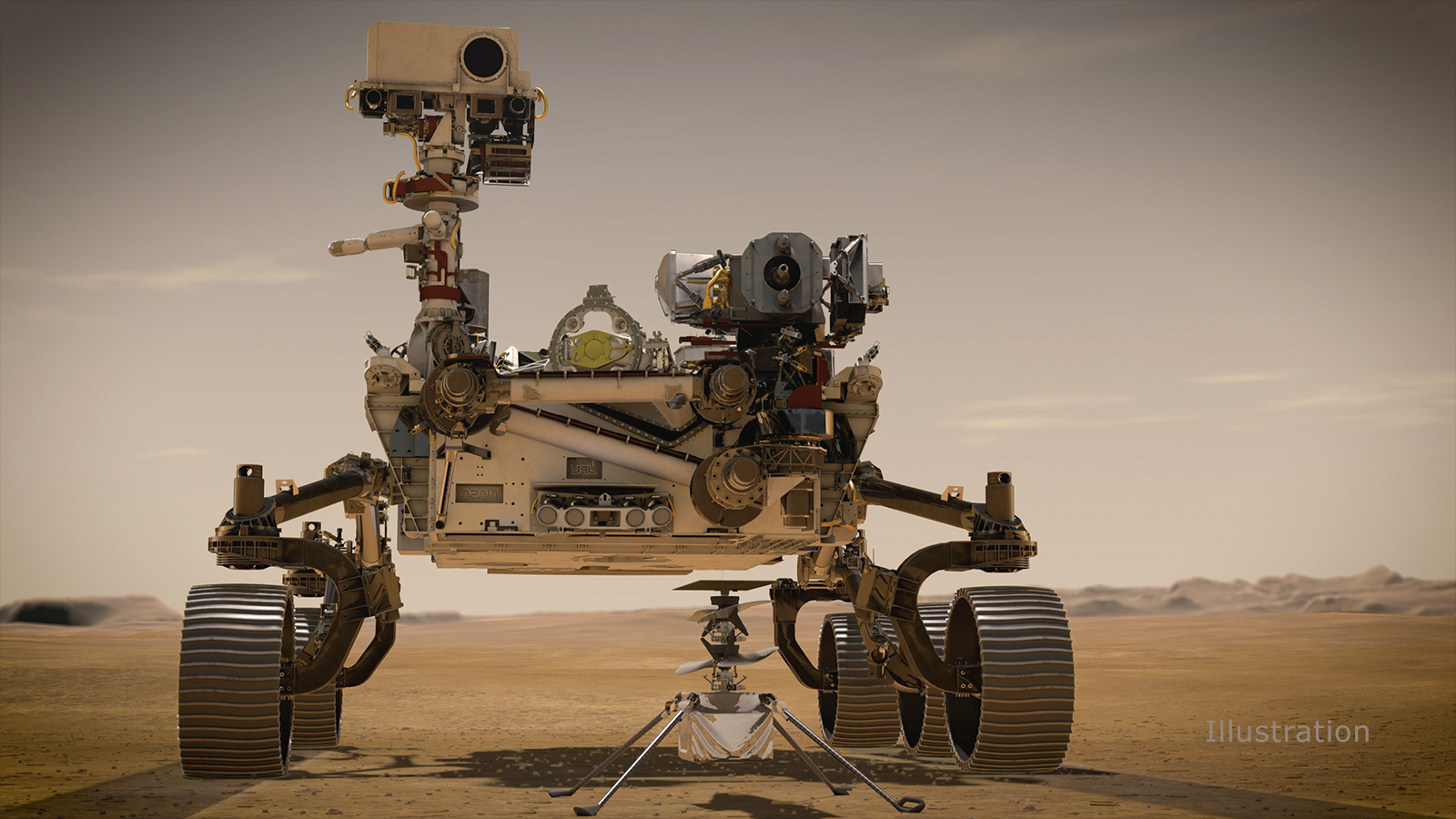
Lançada em 30 de julho de 2020, a rover Perseverance chegará a Marte em 18 de fevereiro. Se o pouso der certo, a Perseverance será a quinta rover a chegar em Marte. As outras são a Sojourner, Spirit, Opportunity e Curiosity (outras sondas famosas, como a Nasa InSight, são módulos estacionários, não rovers). O veículo de seis rodas e pouco mais de uma tonelada é equipado com vários instrumentos, incluindo 23 câmeras diferentes, um dispositivo para monitorar o clima marciano, um espectrômetro ultravioleta para escanear a superfície em escalas microscópicas, um radar que penetra no chão, além de vários outros brinquedos legais.
A Perseverance ainda vai retirar amostras da superfície de Marte e depositá-las em pequenos recipientes que voltarão para a Terra durante uma missão subsequente.
Ilustração da Perseverance
A rover aterrissará na cratera Jezero, região de um antigo lago, onde a Perseverance irá procurar por sinais de vida antiga. Ela também será equipada com um pequeno helicóptero chamado Ingenuity, que será a primeira aeronave a voar em outro planeta (o que nos dá sérios arrepios).
Em 23 de abril a missão da China Tianwen 1 também chegará a Marte. Essa será a primeira missão chinesa no Planeta Vermelho e levará 13 carregamentos científicos diferentes — sete dentro de um orbitador e seis em uma rover. O orbitador usará radar, espectrômetro, magnetômetro e outros instrumentos para estudar Marte a partir da órbita. Já a rover de aproximadamente 240 kg chegará com câmeras, radar de penetração no solo, detector de campos magnéticos, detector de superfície composta e outros instrumentos que estudarão a região de Utopia Planitia.
Os Emirados Árabes também enviarão a Hope, sua primeira missão a Marte. O satélite de aproximadamente 1.300 kg chegará em fevereiro para estudar a atmosfera e o clima marciano. A sonda entrará em uma órbita equatorial única, que se moverá na mesma direção da rotação do planeta. Isso vai permitir que os instrumentos da Hope foquem em um único alvo por períodos prolongados.
Ilustração da Tianwen-1 Fonte: CNSA
A Lua será o lugar para ficar de olho
A Lua se tornou um lugar legal de novo, especialmente com as grandes notícias de 2020 de que ela tem mais água do que pensávamos. Essa água, na verdade, está praticamente em todos os cantos. Algumas missões de 2021 irão continuar a aprofundar nosso conhecimento sobre o maior satélite natural da Terra.
Em julho, a empresa estadunidense privada Astrobotic Technology, lançará a Peregrine Missione One pela Nasa. A sonda de quatro pés irá aterrissar na face visível da Lua em uma região chamada Lacus Mortis. Junto com vários itens, a Peregrine enviará instrumentos da Nasa para testar tecnologias de navegação e pouso. Ela ainda depositará o DNA de Arthur C. Clarke, lendário escritor de ficção científica, junto com o DNA e os restos cremados de outros indivíduos.
Outra empresa privada estadunidense, a Intuitive Machines, também enviará um módulo de pouso chamado Nova-C para a Lua durante o terceiro trimestre do ano. Ela irá “capturar imagens óticas brutas da superfície lunar e convertê-las para a medida TRN (Navegação Relativa Terrestre, na sigla em inglês) para poder pousar em até 200 metros do local de pouso pretendido”, de acordo com o site da companhia.
A Rússia voltará à Lua em 2024 com o módulo de pouso Luna 25. Ela irá à cratera Bogulavsky, próxima ao polo sul. A sonda estará equipada com oito instrumentos científicos que serão usados para explorar a região e procurar por sinais de água congelada. A última missão russa para a Lua foi em 1976, com a missão Luna 24.
Por fim, a Índia enviará a Chandrayaan-3 que fará um pouso suave de um rover no polo sul lunar. O lançamento está marcado para o vim de 2021, mas poderá ser adiado para 2022. A expectativa é que essa missão se saia melhor do que a Chandrayaan-2, quando a sonda Vikram se chocou com o solo lunar por conta de um problema de comunicação.
Foguetes decolando
Alguns lançamentos muito importantes estão marcados para 2021, mas talvez nenhum seja tão importante quanto o lançamento inaugural do SLS (Sistema de Lançamento do Espaço, na sigla em inglês) da Nasa.
Esse é o foguete que supostamente enviará astronautas para a Lua em 2024 como parte do programa Artemis, da Nasa. Eventualmente um dia também levará humanos a Marte. A primeira versão desse foguete gigantesco será capaz de carregar mais de 27 toneladas para órbitas além da Lua, além de alcançar velocidade de aproximadamente 39 mil km/h. O lançamento inaugural está marcado para novembro de 2021, quando o foguete levará uma cápsula não tripulada da Orion para a órbita.
Com Joe Biden assumindo como presidente dos EUA em janeiro de 2021, saberemos mais sobre suas políticas administrativas da Nasa e se a agência espacial ainda continuará com a pretensão de levar tripulação para solo lunar em 2024.
2021 ainda deve ser um ano empolgante para a SpaceX, já que a empresa de Elon Musk pretende enviar um Starship de 50 metros para a órbita. A próxima geração de foguetes deverá levar bagagem e passageiros para órbita da Terra, da Lua e Marte. A empresa também continuará a entregar lotes de satélites Starlink, enquanto continua a construir sua mega constelação de internet banda larga.
A Boeing também deverá fazer o lançamento não-tripulado da nave CST-100 Starline em janeiro, além de um lançamento tripulado no segundo semestre. O problemático programa está atrasado após um teste fracassado e uma notificação da Nasa com nada menos do que 80 recomendações para a empresa melhorar. Dito isso, o sucesso da CrewDragon da SpaceX em 2020 significa que a Nasa ao menos tem uma opção viável para colocar astronautas no espaço.
Após inúmeros adiamentos e muita expectativa, a Nasa lançará (cruzando os dedos) o telescópio espacial James Webb em 31 de outubro de 2021. Essa nova geração de telescópio infravermelho ficará no ponto Terra-Sol L2 Lagrange, a “apenas” 1,6 milhão de km da Terra. Deste ponto, o telescópio conseguirá contemplar o universo primitivo, estudar galáxias e buracos negros supermassivos, além de nos dar novas noções sobre exoplanetas, incluindo suas composições atmosféricas e possibilidades de ser habitáveis.
Outros notáveis lançamentos de 2021 são a nave Lucy, da Nasa, que irá para os asteroides troianos de Júpiter em algum momento entre novembro e outubro; além do Teste de Redirecionamento de Asteroides Duplos da Nasa. A nave do teste visitará o asteroide duplo Didymos e deliberadamente baterá no objeto para testar a nossa capacidade de redirecionar um asteroide perigoso.
Aventuras no espaço profundo
Você se lembra da Juno da Nasa — a sonda responsável por essas imagens incríveis de Júpiter? E como ela detectou raios superficiais e granizo mole no gigante gasoso? Infelizmente ela está chegando ao fim da linha, já que a Nasa planeja tirá-la de órbita e desintegrá-la na atmosfera de Júpiter em 16 de julho (eles farão isso para não contaminar o sistema joviano). Pelo menos a missão durou 41 meses a mais do que a Nasa pretendia.
A Agência Espacial Japonesa de Exploração é a única que coletou amostras de um asteroide (a Hayabusa2 retornou com amostras do asteroide Ryugu no início do mês), mas a nave OSIRIS-Rex, da Nasa, que está no asteroide Bennu, tem altas chances de ter uma câmara cheia de detritos coletados da superfície do corpo celeste. A OSIRIS-Rex deixará Bennu em março, mas só chegará na Terra em setembro de 2023.
A sonda Parker Solar, da Nasa, realizará três periélios (abordagens orbitais mais próximas do Sol) em 2021, aproximando-se cada vez mais de seu fim, que provavelmente acontecerá em 2025. Ela ainda passará por Vênus em outubro, ficando a apenas 3,7 mil km do planeta. Este sobrevoo por Vênus fará com que a sonda consiga se tornar o objeto construído por humanos mais perto do Sol.
Há ainda a Órbita Solar da ESA, que já está estudando o Sol, e entrará oficialmente no estágio principal da missão em novembro. Independente disso, ela já está fazendo trabalhos sensacionais. A ESA tem a Bepi Colombo, que deve entrar na órbita de Mercúrio em 2025, mas chegará mais perto de Vênus em 10 de agosto de 2021 — ficando a apenas 552 km do planeta.
Aventuras espaciais mais perto de casa
Atividades na Estação Espacial Internacional continuarão normalmente, com a tripulação da Expedition 64 fazendo a maior parte do trabalho graças à sua câmara pressurizada, batizada de Nanorock Bishop Airlock, além de fazer vários experimentos bacanas de ciência.
Falando em estações espaciais, a China deve dar um grande passo com a sua. Em algum momento de 2021 o país lançará o módulo Tianhe, que servirá como elemento fundamental da estação espacial chinesa que deverá estar pronta em 2025.
O observatório Vera C. Rubin, no Chile, não vai atingir eu potencial completo até 2022, mas seu telescópio refletor de campo amplo verá sua primeira luz já em 2021. Astrônomos deverão utilizar as instalações para tirar mil fotos por noite, olhando tanto para estrelas próximas quanto para galáxias distantes — a menos que os Starlink de Elon Musk entrem na frente.
Eventos celestiais
Astrônomos amadores terão alguns eventos importantes para observar em 2021, incluindo um eclipse lunar completo em 26 de maio que será visível nos EUA, a maior parte do Canadá, sudeste da Ásia, Austrália, Oceania e partes da América do Sul.
Haverá também um eclipse solar completo em 4 de dezembro, mas só será percebido na Antártica. A África do Sul verá parte do eclipse.
O asteroide potencialmente perigoso Apophis se aproximará um pouco mais da Terra em março, quando ele chegará a 16,9 milhões de km de nosso planeta. Essa será nossa última chance de observá-lo com imagens de radar antes que ele fique muito perto, em 2029, quando chegará a apenas 31 mil km de distância da Terra (um décimo da distância entre o planeta e a Lua). O Apophis tem um chance muito baixa (mas não zero) de bater na Terra em 2068.